
FNIRSI GC-01
4.2Editor score
Built-in GM sensor
Curve display mode
Light vibration alarm
This guide compares the top nuclear radiation detectors for home and professional use. We analyze sensors, accuracy, and alarms to help you choose the best
Finding the right nuclear radiation detector is crucial for safety in homes, labs, or field work. These devices measure ionizing radiation like gamma and beta rays to keep you informed about your environment. Choosing a reliable model ensures you get accurate data when it matters most.
We evaluated ten top-rated models based on sensor quality, user features, and build durability. Our analysis covers everything from budget-friendly counters to professional-grade dosimeters. Each product was reviewed for ease of use, data logging capabilities, and alarm reliability to help you make an informed decision.
Every pick below highlights key strengths, trade-offs, and ideal use cases for different users. Note that product availability and pricing can change quickly on online marketplaces. We recommend checking current stock and warranty details before making your final purchase decision for your safety needs.
4.2Editor score

4.6Editor score

4.5Editor score
This side-by-side comparison highlights the core specifications and capabilities of each model. From sensor types to display features, these details help you distinguish between general purpose and specialized detectors.




The HFS-50-CsI stands out as the top choice for those seeking high precision without compromising portability. Its 4.6 rating reflects user satisfaction with its CsI scintillator sensor which offers better resistance to interference than traditional Geiger tubes.
We may earn a commission when you buy through this link, at no additional cost to you.
Key strengths include its 200-second dynamic waveform curve and colorful dose rate indicators that make data interpretation intuitive. The built-in energy compensation mechanism ensures reliable results across various radiation sources like hospital X-rays.
Trade-offs involve its higher cost and weight compared to basic models, but these are acceptable for the added accuracy. The telescopic rod enhances safety by allowing remote measurements of strong radiation sources without physical proximity risks.
This device is ideal for environmental monitors, lab professionals, or anyone needing reliable long-term tracking. The rechargeable battery and extensive data storage make it perfect for prolonged field use or home safety monitoring.
The CsI scintillator sensor delivers precise readings with a measurement error of only ±10%.
With a 2000mAh battery, it supports up to 70 days in sleep mode for continuous readiness.
We may earn a commission when you buy through this link, at no additional cost to you.
The Radar-9989 is a premium tool designed for professionals who require detection across multiple radiation types. Its USA-made LND7311 sensor provides higher sensitivity and accuracy compared to standard Geiger tubes found in lower-tier devices.
We may earn a commission when you buy through this link, at no additional cost to you.
Users appreciate its ability to measure surface contamination and switch between six different units like μSv/h and Bq/cm² for flexible analysis. The 270-second dose-rate waveform graph helps visualize trends over time during monitoring sessions.
The main trade-off is the high price and the complexity of its feature-rich menu, which may overwhelm casual users. However, for industrial safety or laboratory work, these advanced capabilities justify the additional cost and learning curve involved.
Ideal for lab technicians, industrial safety officers, or serious hobbyists needing alpha detection. The included telescopic rod and storage box ensure it remains protected and functional in demanding field environments.
The mica window sensor allows detection of alpha particles often missed by other detectors.
Customizable visual and audible alarms ensure alerts are noticed even in sleep mode.
We may earn a commission when you buy through this link, at no additional cost to you.
The FNIRSI GC-01 offers an accessible entry point into radiation monitoring without sacrificing essential functionality. With a 4.2 rating, it delivers reliable detection of Gamma, Beta, and X-rays suitable for general home and environmental checks.
We may earn a commission when you buy through this link, at no additional cost to you.
Its standout feature is the curve display that provides a visual representation of radiation levels over time. Users value the smart alarm system which uses light, vibration, and sound to ensure you never miss a dangerous threshold.
Trade-offs include a lower overall rating and simpler build quality compared to premium models. For basic safety checks or uranium glass testing, these limitations are often acceptable given its very competitive price point and user-friendly design.
This unit is perfect for homeowners, travelers, or beginners wanting to monitor background radiation. The bilingual interface and simple clock settings make it versatile for users with different language preferences.
The three-mode alarm ensures you stay alert regardless of your current activity level.
One-handed control and clear settings allow quick adjustments without reading manuals.
We may earn a commission when you buy through this link, at no additional cost to you.
The GQ GMC-300S is praised for its robust data logging capabilities which allow users to track radiation exposure over time. Its 4.6 rating highlights the reliability of its internal memory which stores readings every second for detailed analysis.
We may earn a commission when you buy through this link, at no additional cost to you.
Users benefit from the free PC software that lets you download and visualize historical data. This makes it a strong tool for long-term environmental monitoring where trends matter more than instant readings alone.
The device requires connecting to a computer to fully utilize its data features, which adds a step to your workflow. However, the rechargeable battery and dosimeter mode make it a solid choice for regular users.
Ideal for researchers or homeowners tracking background changes across seasons. The graph mode and CPM count options provide flexible ways to view your collected safety data.
Second-by-second data storage ensures no radiation spikes go unrecorded.
Graph modes help identify patterns in radiation levels throughout the day.
We may earn a commission when you buy through this link, at no additional cost to you.
The GQ 320S combines classic functionality with practical features like a swivel display for better viewing angles. With a 4.5 rating, it is valued for its simplicity and reliability in detecting radiation in various environments.
We may earn a commission when you buy through this link, at no additional cost to you.
Its internal memory logging allows you to review past readings without needing extra software immediately. The long-lasting rechargeable battery ensures the device stays ready for emergencies or extended field trips.
While it lacks some advanced curve displays found in newer models, its straightforward interface makes it easy to use quickly. The dosimeter mode is particularly useful for tracking personal exposure over short or long periods.
This model suits those who prefer simplicity and durability over complex menus. It is ideal for personal safety checks or quick inspections where speed and reliability are the top priorities.
The swivel display helps you read data comfortably from different angles.
Internal memory keeps your logs safe even if the battery runs low.
We may earn a commission when you buy through this link, at no additional cost to you.
The ND01 is designed for those who need a lightweight, pocket-friendly tool for quick checks. Its compact size and clear LCD make it convenient for travelers or casual users needing a radiation check on the go.
We may earn a commission when you buy through this link, at no additional cost to you.
The three-in-one alarm system uses green, yellow, and red indicators to communicate risk levels instantly. This color-coded approach simplifies interpretation for users who may not know complex radiation metrics or units.
With a 3.7 rating, it is clear that this model trades some accuracy and battery life for portability. The reliance on AAA batteries means you must keep spares handy for consistent monitoring in the field.
Ideal for emergency kits or quick home inspections where portability is key. The auto power-off feature helps conserve battery life when the device is not in active use.
Color indicators remove guesswork by showing safe or dangerous status clearly.
Small size allows you to carry it in any pocket or small bag.
We may earn a commission when you buy through this link, at no additional cost to you.
This tester offers a balanced mix of modern features and essential radiation detection capabilities. Its Type-C charging port adds convenience compared to older models using proprietary cables or batteries.
We may earn a commission when you buy through this link, at no additional cost to you.
Users can switch between dual alarm modes to suit different situations or noise preferences. The slim and drop-resistant design makes it durable enough for everyday carry or light field work.
While the 4.0 rating suggests it is competent, it lacks some of the refined features of top-tier models. However, for general purpose use, it delivers reliable performance without breaking the budget for safety tools.
Ideal for individuals seeking a versatile detector for home, office, or travel. Its ease of use and clear interface make it a safe choice for beginners starting their radiation awareness journey.
Type-C charging ensures compatibility with modern cables and power banks.
Adjustable alarms let you tailor notifications to your specific environment needs.
We may earn a commission when you buy through this link, at no additional cost to you.
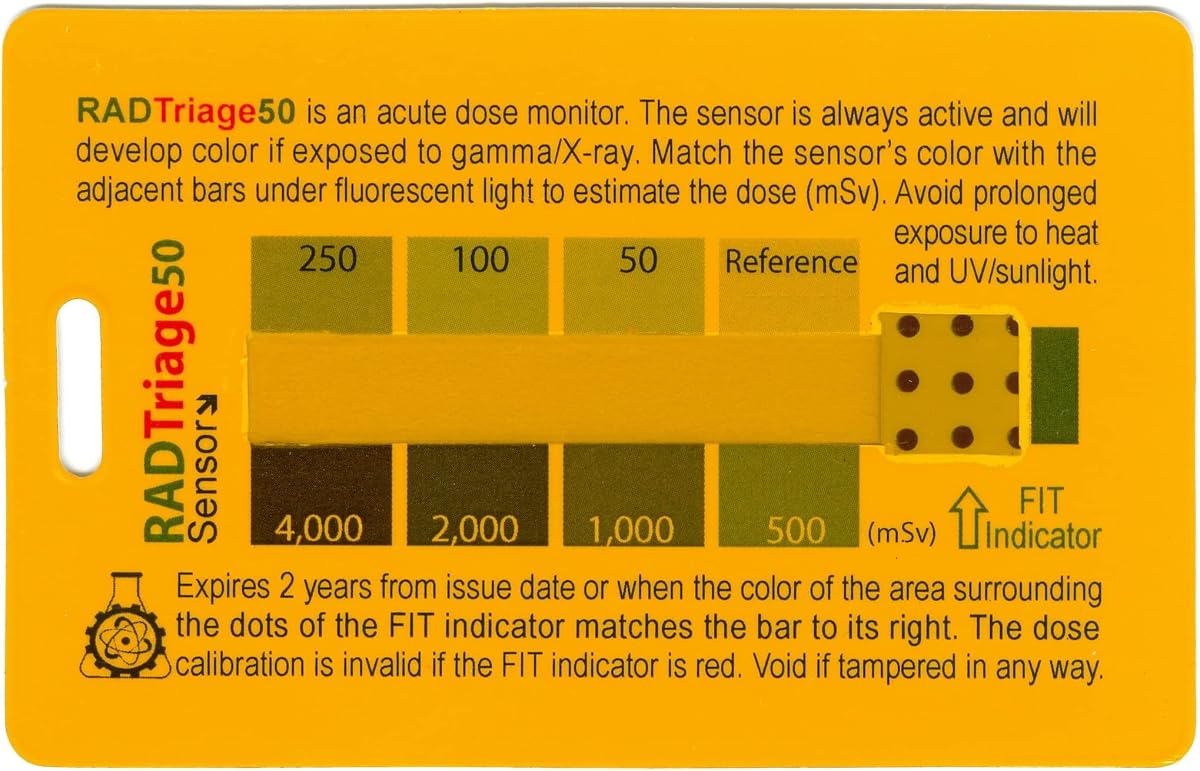
The Rad Triage 50 is unique as a passive dosimeter that requires no batteries or calibration to function. Its 4.4 rating reflects its trustworthiness for emergency situations where electronic devices might fail or run out of power.
We may earn a commission when you buy through this link, at no additional cost to you.
Designed to fit in a wallet, it provides peace of mind by detecting Beta, Gamma, and X-rays without active management. Its shelf life can be extended to ten years with proper storage, ensuring it is ready when needed most.
The main trade-off is the lack of a digital display, meaning you cannot see real-time readings or specific dose rates. It indicates exposure through color changes, making it suitable for emergency preparedness rather than active monitoring.
Ideal for emergency kits or travel where reliability without power is essential. Its military-grade approval and EMP resistance make it a solid choice for critical preparedness.
No batteries mean it functions instantly even when power grids are down.
Freezer storage extends its usable life, keeping it reliable for years.
We may earn a commission when you buy through this link, at no additional cost to you.
The GQ GMC-320 Plus focuses heavily on data integrity and network compatibility for professional environments. Its 4.6 rating highlights its robust data recording features which allow you to save and analyze readings on a PC.
We may earn a commission when you buy through this link, at no additional cost to you.
With an open communication protocol, this model supports a wide range of radiation network setups and integration. This makes it a valuable tool for researchers who need to aggregate data from multiple sources.
The interface may feel dated compared to newer color screen models, but its functionality is solid. The technical support forum adds value for users who need help troubleshooting complex data logging issues.
Ideal for research labs or industrial sites requiring networkable equipment. Its ability to play back data later ensures you never lose critical exposure history.
Open protocol allows integration with other systems for broader monitoring.
Recording features ensure data is preserved for later scientific analysis.
We may earn a commission when you buy through this link, at no additional cost to you.
While distinct from ionizing radiation detectors, the ERICKHILL EMF Meter is valuable for checking household appliances and wiring. It measures magnetic fields in mG/µT and electric fields in V/m to help you identify potential exposure hotspots.
We may earn a commission when you buy through this link, at no additional cost to you.
Its sound and light alarms trigger when levels exceed safety standards, providing immediate feedback. The clear LCD and data hold function make it easy to log readings for appliances without holding the button.
The limitation is that it does not detect gamma or beta rays, so it cannot replace a Geiger counter for nuclear safety. However, it complements radiation safety checks by covering the electromagnetic spectrum you encounter daily.
Ideal for home office safety checks or shielding verification. Its rechargeable battery and compact design make it practical for ongoing monitoring of your living and working spaces.
Measures both electric and magnetic fields for a complete electromagnetic safety check.
Verify if your home appliances are within safe electromagnetic exposure limits.
We may earn a commission when you buy through this link, at no additional cost to you.
Choosing the right detector depends on your specific needs, from casual home safety to professional lab work.
Different detectors use different sensors like Geiger-Müller tubes or CsI scintillators. GM tubes are common and good for general gamma detection, while scintillators offer higher sensitivity and better interference resistance.
Choose a sensor that matches the type of radiation you expect to encounter most often.
Ensure the device can measure both low background levels and high-risk scenarios. Look for models that offer microsieverts per hour (μSv/h) and millisieverts (mSv) readings for complete coverage.
A wider range allows you to use the same device for daily checks and emergency situations.
For long-term monitoring, data logging is essential. Look for internal memory or PC software support that lets you track exposure over days or weeks to spot trends.
If you need historical records, a device with data download capability is far superior to one with only real-time display.
A reliable alarm should include visual, sound, and vibration options. Customizable thresholds ensure you are alerted only when levels exceed safety standards rather than during normal fluctuations.
Multi-sensor alarms are crucial for noisy environments where a beep might be missed.
Long battery life ensures your detector is ready when needed. Rechargeable lithium batteries are convenient, but some models still use standard AAA batteries which are easier to replace in the field.
Prioritize models with extended battery life if you plan on using the device continuously.
Consider how often you will carry the device. Pocket-sized units are great for personal monitoring, while larger models might offer better screens but are less convenient for travel.
A lightweight design ensures you won't hesitate to bring the detector with you.
User interfaces should be intuitive. Menus that allow quick access to readings or alarm settings save time in critical situations.
Simple, clear displays reduce confusion and make the device accessible to beginners.
Look for drop-resistant designs and rugged materials if you will use the detector outdoors or in field conditions. Protective cases or built-in robustness add years to the device's lifespan.
A durable casing ensures the electronics survive accidental drops during active use.
Start by fully charging or installing batteries in your detector. Turn it on and allow it a few minutes to stabilize before taking readings to ensure accurate baseline data.
Hold the device away from your body and point the sensor toward the area you want to test. Keep it parallel to the source for consistent results, especially when testing small objects like jewelry or antiques.
Regularly check the device calibration if recommended by the manufacturer. Store it in a cool, dry place when not in use to protect the sensor and electronics from environmental damage.
Accuracy depends on the model and sensor type. High-end models with scintillator sensors can be within ±10% accuracy, while basic Geiger counters might vary more. Always look for calibration details in the product specs.
Yes, most portable detectors are designed for home use. They can check for radiation in renovation materials or antique items. Ensure the device is sensitive enough for low-level environmental checks.
Passive dosimeters like the Rad Triage do not need calibration. Active digital devices should be calibrated annually or according to the manufacturer's guidelines to maintain accuracy over time.
Geiger-Müller tubes detect ionizing radiation and are common in budget models. Scintillators are more sensitive and can distinguish between radiation types better, making them ideal for precise measurements.
These detectors measure ionizing radiation from solid or air sources. While they might detect radiation near containers, testing water requires specialized methods and equipment rather than a handheld counter.
Look for units like μSv/h (microsieverts per hour) or CPM (counts per minute). These are standard metrics that help you compare readings against safety guidelines.
We selected the HFS-50-CsI as the best overall due to its precision and robust features. The FNIRSI GC-01 offers great value for budget-conscious users, while the Radar-9989 is unmatched for professionals.
Prioritize sensor type and battery life based on your specific needs. If you need to log data, ensure the model supports PC downloads. For emergency preparedness, consider passive options like the Rad Triage.
Prices and availability change frequently, so verify current details before purchasing. Investing in a reliable detector ensures you have peace of mind knowing your environment is safe.