
Akamatis Human Presence Sensor v2.2
4.4Editor score
Compact plug-and-play design with USB-C
Pre-flashed ESPHome firmware included
Adjustable sensitivity for diverse environments
Compare the top 10 Mmwave Human Presence Sensors for October 2026. This guide reviews radar sensors for smart home automation, lighting control, and occupancy
Smart home automation has evolved significantly with the introduction of mmWave human presence sensors. These devices use advanced radar technology to detect even the slightest movements, ensuring lights and devices respond accurately to your presence. Unlike traditional motion sensors, they can identify stationary users, solving common frustrations like lights turning off while reading.
We have carefully evaluated ten leading Mmwave Human Presence Sensors available in the market today. Our comparison focuses on detection accuracy, connectivity protocols, ease of setup, and overall performance in real-world scenarios. Each product was assessed based on technical specifications, user feedback, and compatibility with popular smart home ecosystems.
Each selection in this guide highlights key features, pros, and cons to help you make an informed decision. Whether you prioritize budget, premium features, or specific integration needs, this list covers a wide range of options. Please note that product availability and pricing can change frequently, so verify details before purchasing.
4.4Editor score

5.0Editor score

4.3Editor score
This side-by-side comparison highlights the core specifications and capabilities of each Mmwave Human Presence Sensor reviewed in this guide. It helps you quickly identify which model best fits your specific smart home needs and budget constraints.




The Fermion C4002 mmWave Human Presence Sensor stands out as the top choice for smart home enthusiasts seeking precision and reliability. With a perfect rating, this device excels at detecting micro-movements such as breathing, ensuring lights remain on even when you are stationary. Its native support for ESPHome and Home Assistant makes it a favorite among DIYers.
We may earn a commission when you buy through this link, at no additional cost to you.
Key strengths include its ability to detect static presence up to 10 meters and micro-motion up to 11 meters. The integrated light sensor allows for sophisticated automation rules based on ambient light levels. Additionally, the adaptive background noise learning algorithm effectively filters out interference from fans or curtains, reducing false triggers significantly.
While the device offers incredible functionality, it requires a UART connection to an ESP32 controller and some familiarity with flashing firmware. This technical barrier might be steep for casual users but is manageable for those comfortable with DIY smart home projects. The comprehensive documentation helps mitigate this learning curve.
Ideal for users who want full control over their automation without relying on proprietary cloud services, this sensor delivers unmatched value. It is perfect for bedrooms, offices, and living rooms where detecting stillness is crucial. If you prioritize accuracy and local privacy, this model is the definitive choice.
The sensor detects three types of presence: motion, static, and micro-motion, solving the issue of lights turning off during reading or working.
All sensor data is processed locally within your network, limiting exposure to third-party cloud services and enhancing home privacy.
We may earn a commission when you buy through this link, at no additional cost to you.
The Akamatis Human Presence Sensor v2.2 offers an accessible entry point into mmWave technology for Home Assistant users. Its high rating reflects its reliability in detecting both motion and stationary objects up to 20 feet indoors. The plug-and-play design simplifies installation significantly compared to other DIY options.
We may earn a commission when you buy through this link, at no additional cost to you.
This sensor uses the HLK-LD2410B radar module and Seeed C3 controller to ensure precise detection. The external Wi-Fi antenna enhances connectivity stability, allowing for seamless integration into existing automations. Being pre-flashed with ESPHome means you can connect to the device hotspot and configure Wi-Fi without manual flashing.
The primary limitation is its exclusivity to Home Assistant, which limits flexibility for users in other ecosystems. Additionally, it requires a constant power source via USB-C rather than batteries. However, for budget-conscious users already invested in Home Assistant, these trade-offs are often acceptable given the performance.
This device is best suited for homeowners who want a cost-effective solution for lighting automation in rooms where people may remain still. Its compact design fits well in most interiors. If you value affordability and Home Assistant integration, this sensor delivers excellent performance.
The device comes pre-flashed with ESPHome firmware, allowing you to connect via hotspot and configure Wi-Fi without technical flashing steps.
All main components are FCC-certified, ensuring compliance with regulatory standards and reliable operation in home environments.
We may earn a commission when you buy through this link, at no additional cost to you.
The LWR02 5-in-1 Presence Sensor is a premium solution that combines presence, motion, temperature, humidity, and ambient light sensing in one device. Its robust construction and advanced connectivity make it ideal for comprehensive smart home setups. The dual-sensor design ensures accurate detection while minimizing false alarms.
We may earn a commission when you buy through this link, at no additional cost to you.
By using both PIR and mmWave radar, the device captures all movement types efficiently. The PIR sensor handles walking movements while the mmWave detects breathing or stillness. This hybrid approach optimizes power usage and accuracy. The IPX3 splash-proof rating expands usability to bathrooms and kitchens.
The requirement for a Thread border router and the higher price are considerations for budget users. However, the ability to replace multiple sensors with one unit saves space and installation effort. The two-year battery life ensures minimal maintenance, making it a reliable long-term investment.
For those seeking a high-end sensor that supports future smart home standards like Matter, this model is unmatched. It provides full room context in a single read, ideal for complex automation scenarios. If you value versatility and long-term compatibility, this sensor is a top contender.
This device tracks presence, motion, temperature, humidity, and ambient light simultaneously, eliminating the need for stacking single-purpose sensors.
Operating on Matter over Thread ensures compatibility with existing smart home ecosystems without needing a new hub.
We may earn a commission when you buy through this link, at no additional cost to you.
The Akamatis Litos v3 combines mmWave presence detection with an integrated ambient light sensor, making it perfect for rules requiring both occupancy and lighting data. Its unique front design allows natural light to pass through, ensuring accurate measurements without additional hardware. This integration streamlines automation for living rooms and offices.
We may earn a commission when you buy through this link, at no additional cost to you.
The sensor uses the HLK-LD2401 mmWave radar to detect motion and stationary objects up to 6 meters. The VEML7700 light sensor provides readings that closely match the human eye, ideal for determining when lights should turn on. Setup is simplified by pre-flashed ESPHome firmware.
While excellent for Home Assistant users, the strict requirement for this platform limits its appeal. The device does not support other hubs or cloud services directly. However, for those deep into the Home Assistant ecosystem, the seamless integration and reliable performance justify this limitation.
Ideal for automations that need to know if a room is both occupied and dark, this sensor excels. It is best placed where light levels vary, such as near windows. If you need precise light data alongside presence detection, this model is a strong choice.
The built-in light sensor ensures accurate ambient light readings, enabling automations that respond to both presence and room brightness.
The 3D-printed front panel allows light to pass through naturally, adding a modern aesthetic while maintaining sensor functionality.
We may earn a commission when you buy through this link, at no additional cost to you.
The SONOFF SNZB-06P24 offers unique zone positioning capabilities, allowing users to focus detection on specific areas within a room. This feature helps ignore unwanted zones like corridors while monitoring key areas like desks. The self-learning calibration adapts to your environment, filtering out interference from airflow or appliances.
We may earn a commission when you buy through this link, at no additional cost to you.
Powered by 24GHz mmWave radar, it detects micro-movements like breathing to ensure reliability even when stationary. The integrated ambient light sensor enables context-aware automations. It works with various Zigbee ecosystems including SmartThings and Alexa, providing flexibility compared to Home Assistant-exclusive models.
While the rating is moderate, it often reflects connectivity nuances or setup learning curves. The need for a Zigbee hub is a baseline requirement for this protocol. However, the advanced features like zone positioning make it a versatile tool for complex layouts where generic sensors might fail.
This sensor is ideal for rooms with multiple activities where different zones require different lighting responses. If you need granular control over detection areas, this model stands out. Its compatibility with major platforms makes it a good all-rounder for SmartThings or Alexa users.
Configure up to 7 detection zones to focus on specific areas like sofas or desks while ignoring unwanted spaces like corridors.
The sensor learns your environment to filter repetitive interference, reducing false triggers from fans or curtains.
We may earn a commission when you buy through this link, at no additional cost to you.
The THIRDREALITY Presence Sensor R2 stands out for its five adjustable sensitivity levels, allowing users to fine-tune detection based on room activity. This feature is particularly useful for distinguishing between high-motion areas like hallways and low-motion zones like bedrooms. Its battery-powered design eliminates the need for outlets.
We may earn a commission when you buy through this link, at no additional cost to you.
The AI-enhanced learning adapts to your space, filtering repetitive interference from curtains or air conditioning. It works seamlessly with Zigbee hubs found in Echo devices, SmartThings, or Home Assistant. The 24GHz mmWave radar ensures reliable detection of both movement and stationary presence.
Some users report occasional connectivity hiccups, which may affect the overall rating. Strong repetitive motion like fans may still trigger detection despite AI filtering. However, for users needing flexibility in placement and sensitivity tuning, this sensor offers robust functionality at a reasonable price point.
It is best suited for environments where you need to prioritize specific movements or minimize false alarms from environmental factors. If you have existing Zigbee hubs and value battery operation, this is a solid option. It provides a balanced approach to smart home presence detection.
Switch between five sensitivity levels to adapt to different environments, such as detecting small gestures or ignoring minor airflow.
Powered by three AA batteries, the sensor can be placed anywhere without worrying about power outlets or complex wiring.
We may earn a commission when you buy through this link, at no additional cost to you.
The Generic MmWave Human Presence Sensor offers basic functionality for users seeking straightforward integration via Zigbee2mqtt. It detects stationary objects more accurately than traditional PIR sensors, ensuring lights stay on during reading or sleeping. Its compatibility with Tuya Zigbee hubs makes it accessible for many smart home users.
We may earn a commission when you buy through this link, at no additional cost to you.
Powered by USB 5V, this sensor requires a constant power source, which is ideal for permanent installations but limits flexibility. The 24G mmWave provides faster response and more accurate distance detection than lower-frequency models. This makes it a practical option for high-traffic areas where speed matters.
While it lacks advanced features like zone positioning or multi-sensor integration, it performs its core function well. The setup process is simple, especially when using Zigbee2mqtt which exposes additional functions like distance and illuminance. For basic needs, this sensor delivers reliable results without complexity.
This sensor is best for users who need a simple presence detector without complex configurations. It works well in entryways or bedrooms where continuous power is available. If you prioritize cost-effectiveness and basic performance, this device is a reliable choice for your automation needs.
Using Zigbee2mqtt allows you to access advanced functions like presence distance and illuminance for detailed automation rules.
The sensor supports Tuya Zigbee hubs, acting as a central bridge for all Tuya smart devices in your home.
We may earn a commission when you buy through this link, at no additional cost to you.
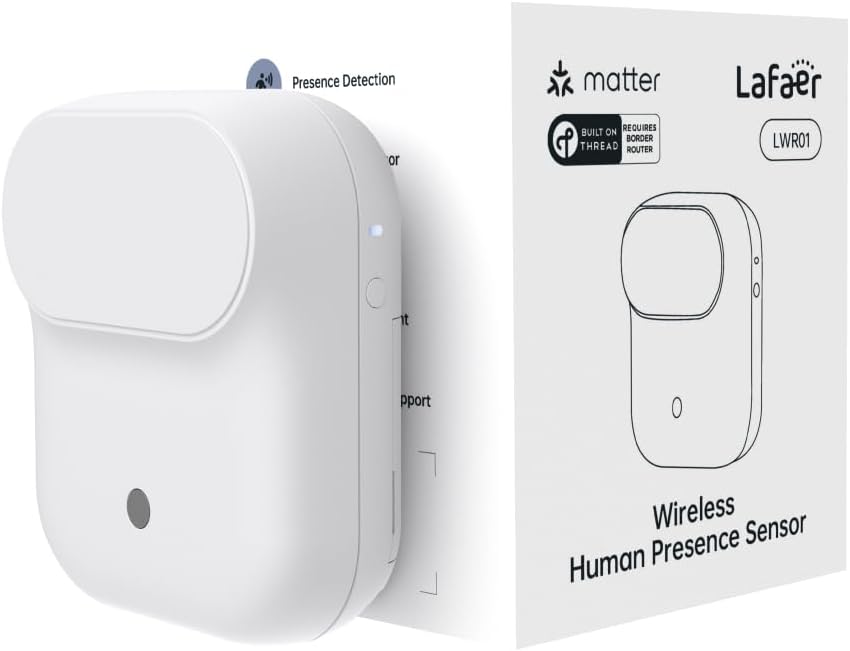
The LWR01 supports Matter over Thread, positioning it as a future-proof option for smart home enthusiasts. This protocol ensures compatibility across platforms like Apple Home and Google Home without needing new hubs. Its battery-powered design offers up to one year of life, simplifying installation significantly.
We may earn a commission when you buy through this link, at no additional cost to you.
With IPX3 water resistance, it can be safely used in bathrooms and kitchens where moisture is common. The mmWave radar detects subtle movements up to 19 feet for motion and 11 feet for stillness, ensuring you are not missed during inactivity. The built-in light sensor aids in energy-saving automations.
The need for a Thread border router may limit availability depending on your current setup. Some users report connectivity variability which affects ratings. However, for those investing in Matter ecosystems, this sensor is one of the few battery-operated presence options available.
Ideal for bathrooms or rooms where power outlets are scarce, this sensor brings modern connectivity to presence detection. If you plan to upgrade to Matter soon, this device ensures you stay ahead of the curve. It is a strong candidate for users prioritizing future compatibility.
Operating on Matter over Thread ensures compatibility with existing smart home ecosystems without needing a new hub.
IPX3 water resistance allows this sensor to be installed in bathrooms and other moisture-prone environments safely.
We may earn a commission when you buy through this link, at no additional cost to you.
The THIRDREALITY R3 features a built-in RGB light that visually indicates presence or system status, adding a unique element to home automation. Utilizing 60GHz mmWave radar, it offers high accuracy for subtle micro-movements like breathing. The Zigbee repeater function helps extend your mesh network range effectively.
We may earn a commission when you buy through this link, at no additional cost to you.
It combines presence detection with ambient light and air quality monitoring (TVOC), offering environmental awareness beyond simple occupancy. The red indicator flashes if dangerous air quality is detected. This sensor integrates well with Home Assistant, SmartThings, and Homey platforms via Zigbee.
Users note that some advanced features like TVOC depend on platform support, limiting utility if your hub does not parse those entities. The constant USB-C power requirement limits placement options. However, the visual feedback and network extension make it a functional tool for smart homes needing enhanced connectivity.
Best for living spaces where visual cues about room status are valuable, this sensor provides a modern touch. It is also a good choice for users needing a Zigbee repeater to boost signal. If you value aesthetics and network support, this model offers compelling advantages.
The built-in RGB light indicates presence or automation states, allowing you to see room occupancy at a glance.
Using Zigbee 3.0, the sensor integrates smoothly with platforms and functions as a Zigbee repeater to strengthen your mesh network.
We may earn a commission when you buy through this link, at no additional cost to you.
This Generic Zigbee Human Presence Sensor provides an affordable entry into mmWave technology, detecting stationary people where traditional motion sensors fail. It is designed for basic home automation scenarios like turning lights on when entering a room. Compatibility with major Zigbee hubs makes it accessible to many users.
We may earn a commission when you buy through this link, at no additional cost to you.
The device uses 24GHz radar to detect presence up to 20 feet away. Powered by two AAA batteries, it offers up to two years of life, reducing maintenance. While simple, it solves the common issue of lights turning off during reading or sleeping, providing a truly intelligent experience.
Some reports indicate variable reliability compared to premium models. The feature set is basic, focusing on core presence detection without advanced analytics. However, for budget users prioritizing core functionality, this sensor performs well. It is best suited for straightforward rooms where complex zoning is unnecessary.
If you need a simple replacement for PIR sensors without spending much, this is a practical choice. It works well in bedrooms and living rooms where stationary presence is common. Verify hub compatibility before purchase, but expect decent performance for everyday automation tasks.
Detects even when you are still, solving the lights turning off issue of standard motion sensors.
Works seamlessly with Echo devices, SmartThings, Hubitat, and other Zigbee hubs for easy integration.
We may earn a commission when you buy through this link, at no additional cost to you.
Selecting the right sensor involves understanding its technical capabilities and compatibility with your existing ecosystem.
Mmwave sensors typically connect via Wi-Fi, Zigbee, or Matter over Thread. Wi-Fi sensors offer direct cloud access but may strain your network. Zigbee requires a hub but provides a stable mesh network with low power usage. Matter over Thread is the newest standard, ensuring future compatibility across ecosystems like Apple Home and Google Home.
Check which protocols your current smart home hub supports before buying. Zigbee is widely supported by Echo and SmartThings hubs. If you use Home Assistant, Wi-Fi or Zigbee with Zigbee2mqtt offers maximum flexibility.
The detection range determines how far the sensor can detect movement or presence. Most devices offer ranges between 4 to 10 meters. Larger rooms require sensors with greater range to ensure coverage. However, longer ranges might increase false triggers if they detect activity outside the target room.
Choose a range that matches your room size. For small bedrooms, 4 meters is sufficient. For living rooms or offices, aim for sensors offering 10 meters or adjustable range settings to avoid wall penetration.
Traditional motion sensors fail when you are stationary, leading to lights turning off during reading or working. True mmWave presence sensors detect static occupancy through micro-movements like breathing. This ensures continuous detection as long as you are in the room, regardless of movement.
Always prioritize sensors that explicitly state static or presence detection capabilities. This feature is crucial for automation scenarios involving sitting, sleeping, or stationary work.
Sensors come in battery-powered or wired options. Battery-powered models offer flexibility in placement without needing outlets. Wired models provide continuous operation without worrying about battery changes. Some devices support both, allowing you to switch based on needs.
Consider installation constraints. If power outlets are available, wired models save hassle. For ceilings or tight corners, battery models are more practical. Check battery life specifications to gauge maintenance needs.
Ensure the sensor works with your smart home platform. Some devices require specific software like Home Assistant, while others work out of the box with Alexa or Google Home. Cross-platform support offers more flexibility for different users in a household.
Review the supported platforms list. If you use Home Assistant, check for ESPHome support for better local control. For commercial ecosystems like Apple HomeKit, ensure Matter support is present.
Some models combine mmWave with other sensors like ambient light, temperature, or humidity. Integrated light sensors automate lighting based on daylight, saving energy. Temperature and humidity sensors add environmental monitoring without extra devices.
Decide if you need multifunctional capabilities. If you want a single unit for room context, 5-in-1 sensors reduce clutter. If you only need presence detection, standalone sensors are often more affordable.
Setup ranges from plug-and-play to technical DIY. Pre-flashed firmware devices like ESPHome make integration easy. Others require manual configuration via UART or complex app setups. Consider your technical comfort level before purchasing.
Opt for plug-and-play devices if you prefer simplicity. For advanced users, modular units offer customization. Always check documentation quality to ensure support during installation.
Some sensors process data locally on your network, ensuring privacy by limiting cloud exposure. Others send data to external servers for processing. Local processing is preferred for security-conscious users.
Check if the device supports local-first architecture. Devices like Home Assistant integrations often offer better privacy control than cloud-dependent alternatives.
Install the sensor at a height of 2 to 3 meters for optimal coverage. Mounting it high ensures a wide field of view and avoids false triggers caused by pets or furniture movement on the floor. Avoid placing it behind obstacles like glass or wood that might block the radar waves.
Configure sensitivity settings based on your environment. High sensitivity detects subtle movements but may trigger from airflow. Low sensitivity ignores minor movements but ensures stability in high-traffic areas. Test the settings for a few days to find the right balance.
Keep the sensor clean and free from dust. Regularly check firmware updates to ensure compatibility with your smart home ecosystem. For battery models, monitor the battery levels through your app to avoid unexpected downtime during peak usage.
An Mmwave Human Presence Sensor uses millimeter-wave radar to detect human occupancy, including stationary presence. Unlike traditional motion sensors that only detect movement, mmWave sensors can sense micro-movements like breathing, ensuring reliable automation for lighting and HVAC systems.
It depends on the connectivity protocol. Zigbee and Matter over Thread sensors typically require a compatible hub or border router. Wi-Fi sensors connect directly to your network. Check your smart home ecosystem to determine if you already have the necessary hardware.
MmWave radar can penetrate thin non-metallic materials like drywall or wood, but this often leads to false triggers. Most modern devices include software filtering or range gates to prevent detecting activity in adjacent rooms. Proper placement helps minimize this risk.
Yes, mmWave sensors do not capture images or audio. They detect changes in electromagnetic waves to determine presence. Devices that process data locally offer better privacy. Always review privacy settings in your smart home software for added security.
Battery-powered sensors typically last between 6 months to 2 years depending on usage. Factors like frequency of detection and connectivity mode affect battery drain. Many models provide low battery notifications through their apps to ensure timely replacement.
False triggers often occur due to environmental factors like fans or pets. Adjust sensitivity settings or use features like zone positioning if available. Ensure the device firmware is updated, and check that the sensor is placed away from moving objects.
This guide has reviewed ten top Mmwave Human Presence Sensors ranging from budget-friendly to premium models. The Fermion C4002 leads with exceptional accuracy and Home Assistant integration, while the Akamatis v2.2 offers the best entry price point for enthusiasts.
When choosing, prioritize compatibility with your smart home platform and the specific detection needs of your rooms. If you value future-proof technology, look for Matter over Thread support. For complex setups, sensors with adjustable sensitivity and zone positioning provide the necessary control.
Product availability and specifications may change over time. Verify current details and reviews before making a purchase to ensure you get the best value. We hope this guide helps you find the perfect sensor to enhance your home automation experience.