
HiLetgo 3pcs ESP8266 ESP-01
4.2Editor score
Compact ESP8266 Module
Three Wireless Operation Modes
Low Cost Multi-Pack Option
Explore our expert comparison of the top Arduino WiFi Module options for October 2026, evaluating connectivity, performance, and ease of use for IoT projects.
Arduino WiFi Modules are essential for adding wireless connectivity to your embedded projects. Whether you need simple data logging or complex IoT automation, choosing the right module ensures stable communication and efficient power usage.
We evaluated ten top-rated products based on connectivity standards, processing power, and community support. Each option was reviewed for compatibility with Arduino IDE, signal strength, and suitability for various project scales from hobbyist to industrial.
Each pick highlights unique strengths like dual-core processing or low-power modes. Prices fluctuate due to market demand and availability so always verify current listings before purchasing your next wireless development board.
4.2Editor score

4.7Editor score

4.5Editor score
This side-by-side comparison highlights key specifications across all ten selected wireless modules. Evaluate memory, connectivity standards, and voltage requirements to find the perfect match for your specific development needs.



The Arduino UNO R4 WiFi stands out as the most versatile board for advanced projects. It combines a powerful Renesas processor with a dedicated ESP32-S3 chip for wireless tasks.
We may earn a commission when you buy through this link, at no additional cost to you.
Its dual-core architecture allows complex operations like AI processing while maintaining stable Wi-Fi and Bluetooth connections. The integrated LED matrix provides immediate visual feedback without extra components.
While it costs more than basic ESP modules, the added features like USB-C and DAC justify the investment for serious developers. You avoid separate breakout boards for many common tasks.
This board is ideal for prototyping smart home hubs or industrial sensors. Choose it if you need future-proof connectivity and processing power in a single package.
Run intensive logic on the RA4M1 while ESP32-S3 handles network traffic efficiently.
Display status icons or messages directly on the board using the 12×8 matrix.
We may earn a commission when you buy through this link, at no additional cost to you.
The HiLetgo ESP8266 ESP-01 is a classic choice for budget-conscious makers. It offers reliable Wi-Fi capabilities at a fraction of the cost of newer boards.
We may earn a commission when you buy through this link, at no additional cost to you.
Three units in one package make it perfect for multi-device testing or small batch projects. The module supports AP, STA, and mixed modes for flexible networking.
Its compact size means you often need to solder headers or use a breakout board. This adds slight complexity but keeps costs minimal for simple sensor nodes.
Buy this if you need basic connectivity for many small devices. It remains a staple for entry-level IoT development due to its simplicity and price.
Connect as a standalone hotspot or join existing Wi-Fi networks easily.
Get three modules for one price to spread across multiple test projects.
We may earn a commission when you buy through this link, at no additional cost to you.
The ESP8266 ESP-01S improves on the original with better antenna design. It provides stronger signal strength for more reliable connections in challenging environments.
We may earn a commission when you buy through this link, at no additional cost to you.
With 4MB flash memory, you can store larger applications and OTA updates directly. This makes it suitable for projects requiring significant code storage or data buffering.
You must select the generic ESP8266 board option in your IDE to program it successfully. This small step ensures compatibility with the specific flash layout.
Choose this module when range is a priority over cost. It is an excellent middle ground between basic modules and full development boards.
Experience better connectivity through improved RF calibration and antenna design.
Store larger sketches and data logs without external memory chips.
We may earn a commission when you buy through this link, at no additional cost to you.
The Aitrip 5-pack offers great value for prototyping multiple sensors. Five ESP8266 modules ensure you have spares or can deploy a network simultaneously.
We may earn a commission when you buy through this link, at no additional cost to you.
Each unit operates strictly at 3.3V which protects the chip but requires careful power planning. Ensure your regulator outputs stable 3.3V to avoid damage.
The 1MB flash is sufficient for standard tasks but limits complex data logging. For simple telemetry or control, it remains a solid and reliable choice.
Buy this if you need quantity without high cost. It is perfect for testing network layouts or distributing simple sensor nodes across a home.
Deploy five nodes at once to test network coverage and stability.
Operate within strict 3.3V to ensure long-term reliability and safety.
We may earn a commission when you buy through this link, at no additional cost to you.
The ELEGOO ESP-32 boards bring dual-core power to your projects. Running at 240 MHz they handle complex logic while maintaining wireless connections.
We may earn a commission when you buy through this link, at no additional cost to you.
Support for Bluetooth 4.2 allows connection to sensors and smartphones without extra hardware. The USB-C port simplifies programming compared to older micro-USB interfaces.
OTA updates mean you can fix bugs remotely without physical access. This is crucial for deployed devices in hard-to-reach locations.
Choose this when you need more processing power than an ESP8266 offers. The inclusion of three units makes it perfect for team projects or scaling up.
Use both Wi-Fi and Bluetooth to create versatile connected devices.
Update firmware over the air to maintain device security and features.
We may earn a commission when you buy through this link, at no additional cost to you.
The Arduino Nano ESP32 offers next-gen features for serious developers. The ESP32-S3 provides enhanced AI capabilities and improved security features.
We may earn a commission when you buy through this link, at no additional cost to you.
MicroPython compatibility allows you to prototype faster using familiar code. Additionally HID support lets you act as a keyboard or mouse directly.
Without headers you need to solder or use a prototyping board initially. This flexibility helps reduce cost when purchasing but adds a setup step.
Buy this for advanced projects requiring modern protocols. It is a top choice for custom interfaces and Python-based IoT applications.
Code directly in Python for faster iteration and easier debugging.
Turn your device into a USB input peripheral for computers.
We may earn a commission when you buy through this link, at no additional cost to you.
This 4-pack offers reliable performance for repeated prototyping. The RF self-calibration ensures consistent signal strength across different modules.
We may earn a commission when you buy through this link, at no additional cost to you.
Quality materials make these units durable enough for reuse after projects. They are small enough for wearable electronics that need wireless features.
You will need a breakout board to access all pins easily. This adds a tiny cost but simplifies wiring significantly for beginners.
Choose this if you need consistent performance without high cost. It works well for home automation and sensor networks requiring multiple nodes.
Self-calibrated RF tech ensures each unit performs reliably.
Quality construction allows you to reuse modules for new projects.
We may earn a commission when you buy through this link, at no additional cost to you.
This pack provides substantial flash memory for complex code. Each module includes 4MB storage to handle large libraries or data logs.
We may earn a commission when you buy through this link, at no additional cost to you.
The 115200 baud rate ensures fast communication speeds. It supports DOUT protocol which is standard for many flash types.
You must select SPI DOUT mode in your IDE settings. Ignoring this can lead to flashing errors or runtime failures.
Buy this for data-heavy applications needing multiple units. The balance of storage and quantity makes it great for industrial test beds.
4MB flash lets you run advanced scripts without external chips.
Ensure correct SPI DOUT settings for successful firmware uploads.
We may earn a commission when you buy through this link, at no additional cost to you.
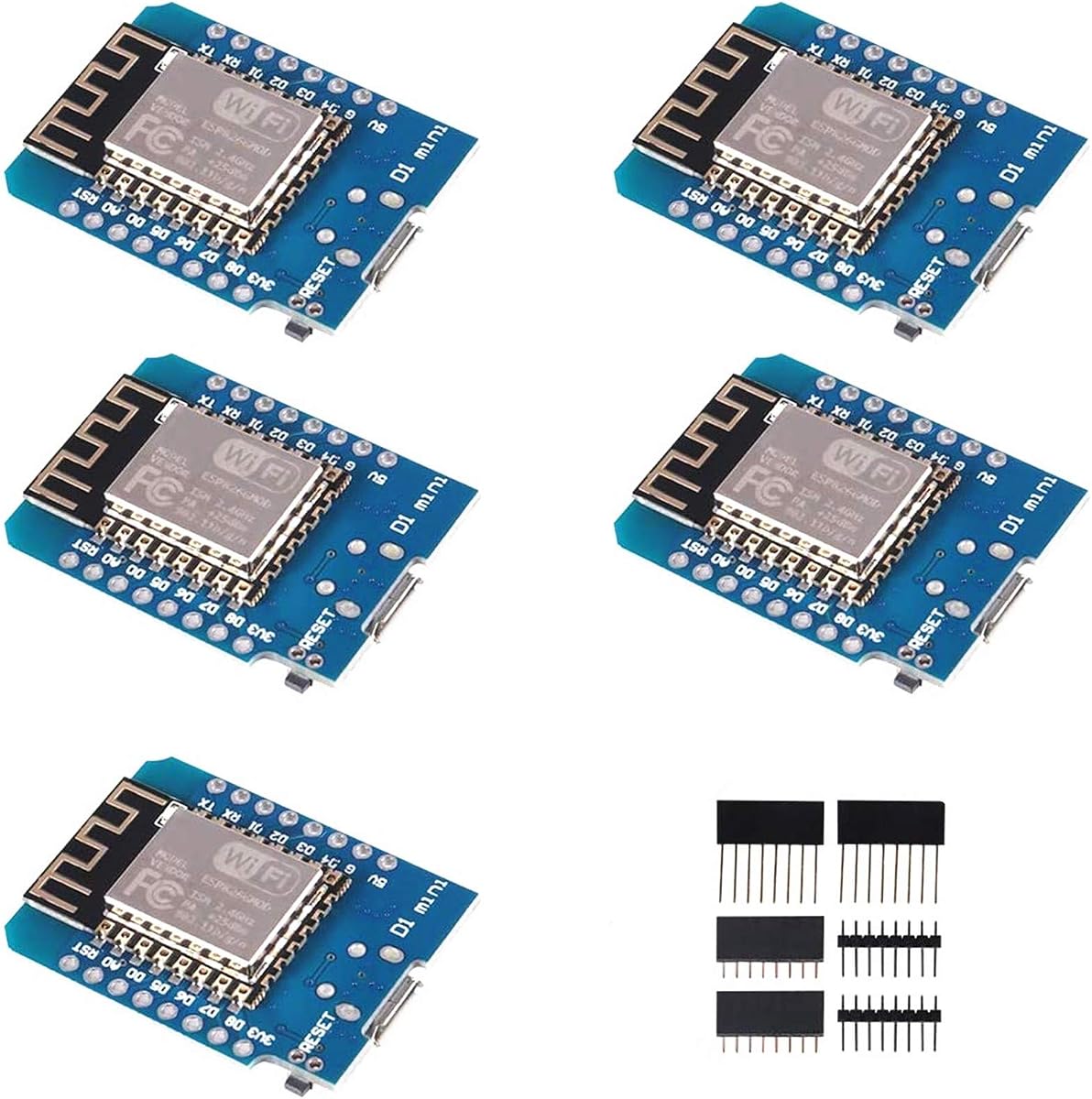
The ESP-12F D1 mini is a compact full-board solution. It includes a power supply and USB interface for easy setup without breakout boards.
We may earn a commission when you buy through this link, at no additional cost to you.
With 11 pins and 4MB storage you have room for multiple sensors. The onboard fuse protects your device against current spikes.
It uses Micro-USB which is less common now but still widely available. This convenience saves you from needing extra power modules.
Choose this for simple standalone projects. It is perfect when you need a plug-and-play WiFi solution without extra wiring.
Onboard power supply allows direct USB connection for operation.
11 digital pins allow multiple sensors and actuators on one board.
We may earn a commission when you buy through this link, at no additional cost to you.
This 10-pack offers the highest volume option for large networks. It is ideal for companies or schools needing many identical units.
We may earn a commission when you buy through this link, at no additional cost to you.
The modules feature robust processing capabilities for consistent performance. LWIP support ensures reliable networking even under load.
You need separate breakout boards for ease of use. However the bulk price per unit makes it very economical for scaling.
Buy this for large deployments needing many nodes. It provides the best value for creating extensive sensor networks quickly.
Ten units cover large networks without reordering.
LWIP stack ensures stable connections even with many devices.
We may earn a commission when you buy through this link, at no additional cost to you.
Selecting the right WiFi module involves considering connectivity, power needs, and development environment. This guide breaks down the critical factors to ensure compatibility with your specific project.
Different modules support varying Wi-Fi generations like 802.11n or newer. Bluetooth versions also differ with 4.2 and 5.0 offering range and speed improvements.
Choose the standard that matches your router and device requirements.
Some modules like ESP-01 run on 3.3V only while others accept broader ranges. Always check the voltage tolerance to avoid damaging the component.
Ensure your power supply matches the module's strict voltage needs.
Flash memory varies from 1MB to 4MB or more. Larger storage allows for complex sketches or OTA updates without external chips.
Pick a module with enough flash for your code and data logs.
Modern boards use USB-C while older modules rely on Micro-USB or require serial converters. USB-C offers reversible and faster connectivity.
Consider the interface ease of use in your workflow.
Modules range from tiny chips to full development boards. Smaller chips save space but require soldering while boards offer direct USB access.
Select based on whether you need integration or rapid prototyping.
Popular modules like ESP8266 and ESP32 have vast community resources. Libraries and tutorials are easier to find for widely adopted chips.
Opt for mainstream options if you need quick help or samples.
Buying single units is fine for testing while multi-packs save costs. For production or bulk prototyping consider 5 or 10 packs.
Balance cost with your immediate project needs when buying.
Connect your module to a stable power source using the recommended voltage regulator. Ensure ground connections are secure to avoid signal noise during operation.
Install the necessary board support packages in your Arduino IDE. Use the board manager to find and install the required drivers for your specific chip.
Store unused modules in anti-static bags to prevent damage from moisture. Keep them in a cool dry place to maintain soldering quality.
Many modern modules like the ESP32-S3 or ESP-32 include built-in Bluetooth support. Older ESP8266 models generally do not support Bluetooth natively. Check the specifications to confirm wireless options before buying.
ESP32 offers more power and Bluetooth support making it better for complex projects. ESP8266 is cheaper and sufficient for simple Wi-Fi tasks. Choose based on your processing and connectivity needs.
Most ESP modules require 3.3V logic and power. Supplying 5V directly can damage the chip. Use a voltage regulator to step down 5V to 3.3V for safe operation.
Use the Arduino IDE and install board support packages. Select the correct board type in the tools menu. Connect via USB or serial adapter to upload your code.
Over-the-Air updates allow you to update firmware wirelessly. This is useful for devices that are hard to reach. Ensure your chosen module supports this feature for remote management.
Yes all listed modules are compatible with Arduino IDE. You may need to install additional board support packages. Always check the documentation for the specific installation steps.
We highlighted top picks ranging from the high-performance Arduino UNO R4 to budget-friendly ESP-01 packs. Each serves different needs from industrial control to hobbyist prototyping.
Prioritize features like dual-core processing or USB-C connectivity if you plan long-term projects. For small sensor nodes compact 3.3V modules offer the best value.
Remember to verify current pricing and availability on Amazon before buying. Technology moves fast and stock levels change often.